When a ship moves forward it produces regions of increased water pressure near its bow and reduced water pressure at its stern. This pressure differential is utilised to drive water through a set of these below-waterline corridor (trunks) without the need for pumps. Although this leads to slight increase in the resistance of the ship, the discharge of the trunk flow into the upper half of the propeller disc tends to smooth out the inflow to the propeller, allowing the propeller to operate at higher propeller efficiency and thus compensate for the added resistance to some extent.
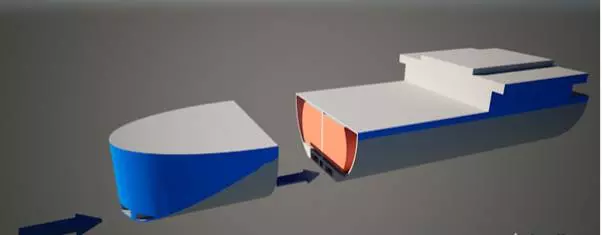
Fig.2:Rendition of the concept behind ballast free ship design
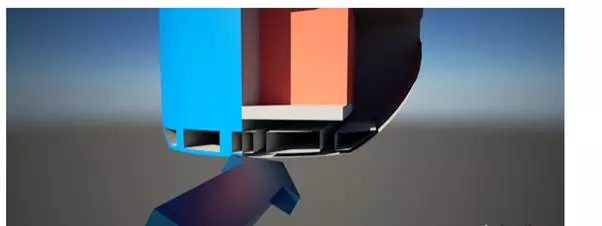
| Fig.2:Rendition of the buoyancy control compartments with provisions for flushing water at normal voyage speeds. |
However, it also has to overcome some other challenges like:
1.) Loss of cargo carrying capacity- due to ballast water volume restraint. As it’s quite difficult to sustain the cargo carrying capacity and also the same ballast water volume
2.) Loss of ship strength- There would be a total redesign of the double bottom. As the conventional transverse framing will create difficulty for ballast water to flow through the tunnels. Hence this elimination will enhance the flow of ballast water at the cost of ship’s strength.
Classification societies might not permit the elimination of all of these frames. Moreover, watertight trunk boundaries will be required at transverse locations. Longitudinal stiffeners could be replaced with sandwich panels, thereby improving the flow. Thus compensating for the loss of strength.
3.) Increase in ship’s resistance- due to disturbance from discharge of ballast water into the flow around the propeller – The introduction of a plenum at the bow and stern of the ship, as well as the location of the plenums will affect the resistance of the ship, increasing fuel consumption.
Also, the increased ballast water flow velocity at discharge location will increase resistance as shown experimentally.
Equipped with such technology, we can hope to minimize our environmental footprint to the greatest possible extent in the different spheres of conflict with the marine ecosystem.