The Steady-State Approximation

senseadmin
1 Min Read
Disclosure: This website may contain affiliate links, which means I may earn a commission if you click on the link and make a purchase. I only recommend products or services that I personally use and believe will add value to my readers. Your support is appreciated!

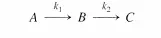
Consider a closed system comprised of two, first-order, irreversible (one-way) elementary reactions with rate constants kl and k2 :
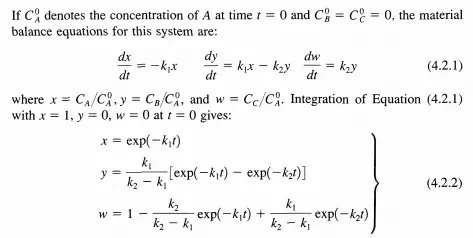
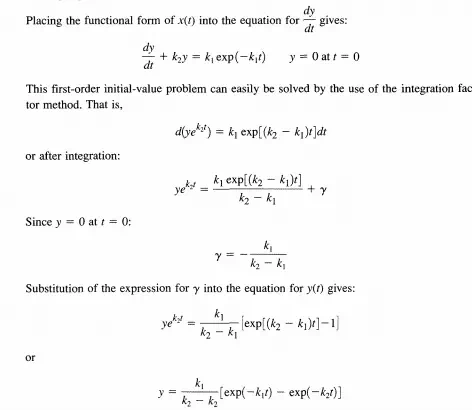
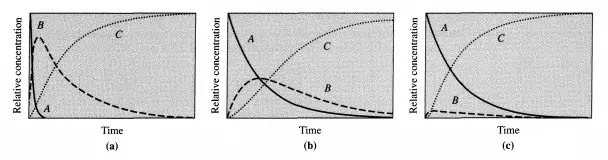
This is the analytical expression of the steady-state approximation: the time d erivatives of the concentrations of reactive intermediates are equal to zero. Equation (4.2.9) must not be integrated since the result that y = constant is false [see Equation (4.2.7)]. What is important is that B varies with time implicitly through A and thus with the changes in A (a stable reactant).

Share This Article
Follow:
Prabhu TL is an author, digital entrepreneur, and creator of high-value educational content across technology, business, and personal development. With years of experience building apps, websites, and digital products used by millions, he focuses on simplifying complex topics into practical, actionable insights. Through his writing, Dilip helps readers make smarter decisions in a fast-changing digital world—without hype or fluff.
Leave a review