PETROL ENGINES
Classification of Petrol Engines
• Two Stroke cycle Petrol Engines
• Four Stroke cycle petrol Engines
TWO STROKE CYCLE PETROL ENGINES:
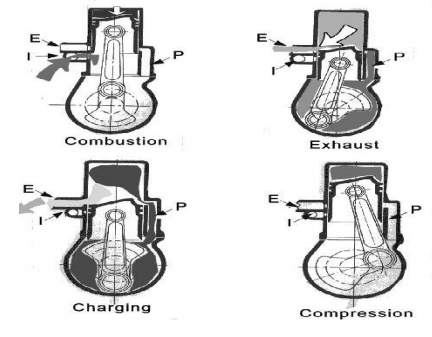
Two Stroke Cycle Petrol Engine – Construction
Construction :
• A piston reciprocates inside the cylinder
• It is connected to the crankshaft by means of connecting rod and crank
• There are no valves in two stroke engines, instead of valves ports are cut on the cylinder walls.
• There are three ports, namely inlet, exhaust and transfer ports.
• The closing and opening of the ports are obtained by the movement of piston. The crown of piston is made in to a shape to perform this.
• A spark plug is also provided.
First Stroke : (Compression, ignition and inductance) (Upward stroke of piston)
(a) compression:
• The piston moves up from Bottom Dead Centre (BDC) to Top Dead Centre (TDC)
• Both transfer and exhaust ports are covered by the piston.
• Air fuel mixture which is transferred already into the engine cylinder is compressed by moving piston.
• The pressure and temperature increases at the end of compression.
First Stroke : (Compression, ignition and inductance) (Upward stroke of piston)
(b) Ignition and Inductance:
• Piston almost reaches the top dead centre
• The air fuel mixture inside the cylinder is ignited by means of an electric spark
• produced by a spark plug
• At the same time, the inlet port is uncovered by the plane.
• Fresh air fuel mixture enters the crankcase through the inlet port.
Second Stroke: (Downward Stroke of the engine) : (c)Expansion and Crankcase compression
• The burning gases expand in the cylinder
• The burning gases force the piston to move down. Thus useful work is obtained.
• When the piston moves down, the air fuel mixture in the crankcase is partially compressed. This compression is known as Crank case compression.
Second Stroke: (Downward Stroke of the engine) :
(d) Exhaust and transfer:
• At the end of expansion, exhaust port is uncovered.
• Burnt gases escape to the atmosphere.
• Transfer port is also opened. The partially compressed air fuel mixture enters the cylinder through the transfer port.
• The crown of the piston is made of a deflected shape. So the fresh charge entering the cylinder is deflected upwards in the cylinder.
• Thus the escape of fresh charge along with the exhaust gases is reduced.