Structures are everywhere in the built environment. Buildings, bridges, tunnels, storage tanks, and transmission lines are examples of a “structure.” Structures differ in their makeup (i.e., the type and configuration of the components), and also in their function. Our approach to describing a structure is based on identifying a set of attributes which relate to these properties.
Structural Components
The components are the basic building blocks of a structure. We refer to them as structural elements. Elements are classified into two categories according to their geometry :
1. Line Elements—The geometry is essentially one-dimensional, i.e., one dimension is large with respect to the other two dimensions. Examples are cables, beams, columns, and arches. Another term for a line element is member.
2. Surface Elements—One dimension is small in comparison to the other two dimensions. The elements are plate-like. Examples are flat plates, curved plates, and shells such as spherical, cylindrical, and hyperbolic paraboloids.
Types of Structures
A structure is classified according to its function and the type of elements used to make up the structure. Typical structures and their corresponding functions are listed in Table 1.1 and illustrated in Fig. 1.1.
A classification according to makeup is listed in Table 1.2 and illustrated in Fig. 1.2.
Table 1.1 Structures classified by function
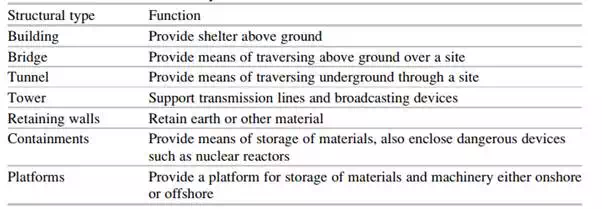


Fig. 1.1 Examples of typical structures classified by function
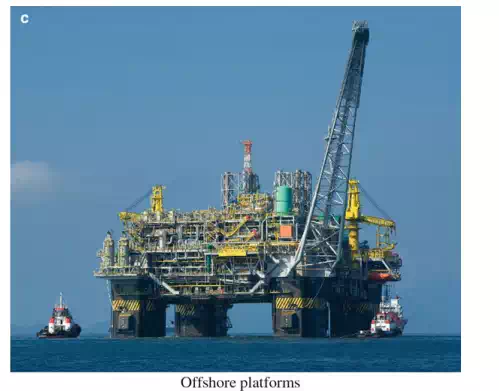
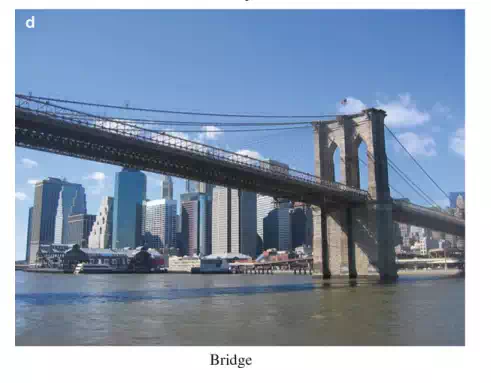
Fig. 1.1 (continued)