
Mutual Funds Guide
What Is Benchmark in Mutual Funds?
A benchmark is a market index used to compare a mutual fund’s performance and risk against a relevant standard. This SenseCentral guide explains the idea in simple language, shows how it affects real decisions, and gives beginners a practical checklist before investing.
Disclaimer: This article is for education only. Mutual fund investments are subject to market risks. Read all scheme-related documents carefully and consider consulting a qualified adviser before investing.
Quick Answer: What Is Benchmark in Mutual Funds
A benchmark is a market index used to compare a mutual fund’s performance and risk against a relevant standard. In practical terms, it is not just a textbook term; it is a decision-making tool. A beginner who understands what is benchmark in mutual funds can ask better questions before investing, compare funds more fairly, and avoid selecting schemes only because they appeared at the top of a short-term return list.
Simple example: A large-cap fund may compare itself with a large-cap index, while an index fund may try to replicate its chosen index. This kind of simple interpretation is often more useful than memorizing financial formulas without knowing how to apply them.
Why What Is Benchmark in Mutual Funds Matters
For beginners, this concept is useful because it turns mutual fund investing from guesswork into a structured decision. When you understand the meaning, the data source, and the limitation of the concept, you can compare schemes more calmly and avoid chasing noise.
Mutual funds are designed for different purposes. Some are built for long-term wealth creation, some for short-term liquidity, some for tax planning, some for income, and some for diversification. Because each fund category behaves differently, every investor needs a way to connect the product with the purpose of money. That is where this topic becomes valuable.
Another reason it matters is behavior. Many beginners enter mutual funds after hearing about high returns, but they exit when markets fall or when another fund looks more exciting. Understanding the basics reduces emotional decision-making. It helps you see whether a fund is doing what it was designed to do, rather than judging it only from recent performance.
How It Works in a Mutual Fund
Every mutual fund scheme has an investment objective, a category, a portfolio, a benchmark, a cost structure, and a risk profile. What Is Benchmark in Mutual Funds should be read along with these details. For example, a risk metric is meaningful only when compared with similar funds. A cost metric is meaningful only when you understand whether the fund is passive or active. A return metric is meaningful only when you know the risk taken to earn it.
Beginners should first identify the fund category. Equity funds, debt funds, hybrid funds, liquid funds, ELSS funds, index funds, ETFs, and balanced advantage funds are not interchangeable. A short-term investor and a retirement investor may both use mutual funds, but they should not necessarily choose the same scheme. The correct fund is the one that fits the job.
Important documents to check
- Scheme Information Document (SID): Explains the scheme objective, strategy, risk factors, expenses, benchmark, and load structure.
- Key Information Memorandum (KIM): Gives a shorter view of key scheme details and investor information.
- Monthly factsheet: Shows portfolio, returns, benchmark comparison, fund manager, expense ratio, riskometer, and sector allocation.
- AMC website and AMFI resources: Useful for verifying official scheme details and investor education information.
A Beginner-Friendly Example
Imagine two investors, Asha and Nikhil. Asha is saving for a home down payment needed in eighteen months. Nikhil is investing for retirement that is twenty years away. Both are interested in mutual funds, but their fund choices should be very different. Asha needs liquidity and lower volatility. Nikhil can accept more market movement because the goal is far away.
Now apply what is benchmark in mutual funds to this example. If the topic is cost, Nikhil must care about long-term compounding. If the topic is risk, Asha must avoid funds that can fall sharply before her goal date. If the topic is fund category, both need to choose products based on purpose rather than popularity. This is the central habit of good investing: start with the goal, then select the fund.
Helpful Comparison Table
| Factor | What to check | Why it matters |
|---|---|---|
| Definition | Understand what what is benchmark in mutual funds means before using it for decisions. | A clear definition prevents costly confusion. |
| Where to find it | Scheme factsheet, fund-house website, platform analytics, SID, KIM, or portfolio disclosure. | Using official documents is better than relying only on social media. |
| How to compare | Compare within the same category and time period. | Comparing unlike funds can lead to wrong conclusions. |
| Beginner risk | Do not treat one metric as the full answer. | Mutual funds require goal, risk, cost, and time-horizon fit. |
| Action step | Add it to your fund-selection checklist. | A checklist makes decisions calmer and repeatable. |
How Beginners Can Use This Information
1. Connect the fund to a goal
Before selecting a scheme, write the goal name, amount required, expected date, and flexibility. A goal due in six months needs a different approach from a goal due in fifteen years. This one step eliminates many unsuitable funds immediately.
2. Compare only similar funds
Do not compare a small-cap fund with a liquid fund, or a tax-saving equity fund with a savings account, as if they are substitutes. Compare funds inside the same category and then examine whether the category itself is suitable for your goal.
3. Look beyond returns
Returns are important, but they are not the full story. Check the expense ratio, benchmark, fund manager history, portfolio concentration, riskometer, standard deviation, drawdown, exit load, tax implications, and consistency across market cycles.
4. Keep the portfolio understandable
A beginner does not need ten funds that all own similar stocks. A simple portfolio is easier to review, easier to rebalance, and easier to continue during volatile markets. Complexity should be added only when it solves a real problem.
Common Mistakes to Avoid
- Chasing last-year winners: Recent top performers can underperform when market leadership changes.
- Ignoring risk level: A high-return fund may be unsuitable if your goal is near.
- Over-diversifying: Too many funds can create overlap and make tracking difficult.
- Forgetting costs and taxes: Expense ratio, exit load, taxation, and platform charges can reduce realized returns.
- Investing without an emergency fund: Long-term investments should not be used as a substitute for emergency savings.
- Copying someone else’s portfolio: Their income, goals, tax situation, and risk comfort may be different from yours.
SenseCentral Mutual Fund Checklist
Use this checklist before investing in any scheme related to what is benchmark in mutual funds. It is simple enough for beginners but still practical for experienced investors who want a clean review process.
- What exact goal will this fund serve?
- When will I need the money?
- Is the fund category suitable for that time horizon?
- What is the scheme benchmark and has the fund been compared with the right benchmark?
- What is the expense ratio, and is it reasonable for the fund type?
- Does the riskometer match my risk comfort?
- Is there any exit load or lock-in?
- Am I investing through a direct plan or regular plan, and do I understand the difference?
- How does this fund fit with my existing portfolio?
- What would make me review, reduce, or exit this fund?
Important: Avoid treating this checklist as a guarantee of returns. It is a decision-quality tool, not a prediction tool. Markets can still move against expectations.
Internal Links and Further Reading on SenseCentral
- What Is Tracking Error?
- What Is Alpha in Mutual Funds?
- Does Higher AUM Mean a Better Fund?
- What Is Sharpe Ratio?
- How to Make Money with Teachable: A Complete Creator’s Guide
Suggested keyword tags for this post: Benchmark, mutual funds, investing for beginners, personal finance, SIP investing, fund selection, financial planning, India investing, Sensecentral, portfolio planning, investment education, risk management
Useful Resources for Creators, Bloggers, and Online Business Owners
Affiliate disclosure: Some links below may be affiliate or partner links. SenseCentral may earn a commission at no extra cost to you if you choose to use them.
Explore Our Powerful Digital Products
Browse high-value bundles for website creators, developers, designers, startups, content creators, and digital product sellers. These resources can help you build faster, design better, and launch digital projects with less friction.
Zee Sharp Free Productivity Tools
Zee Sharp is a growing suite of free online tools for productivity, development, and creativity. No sign-up. No watermarks. Just tools that can help bloggers, creators, students, and small business owners work faster.
Creator Monetization Tool: Try Teachable
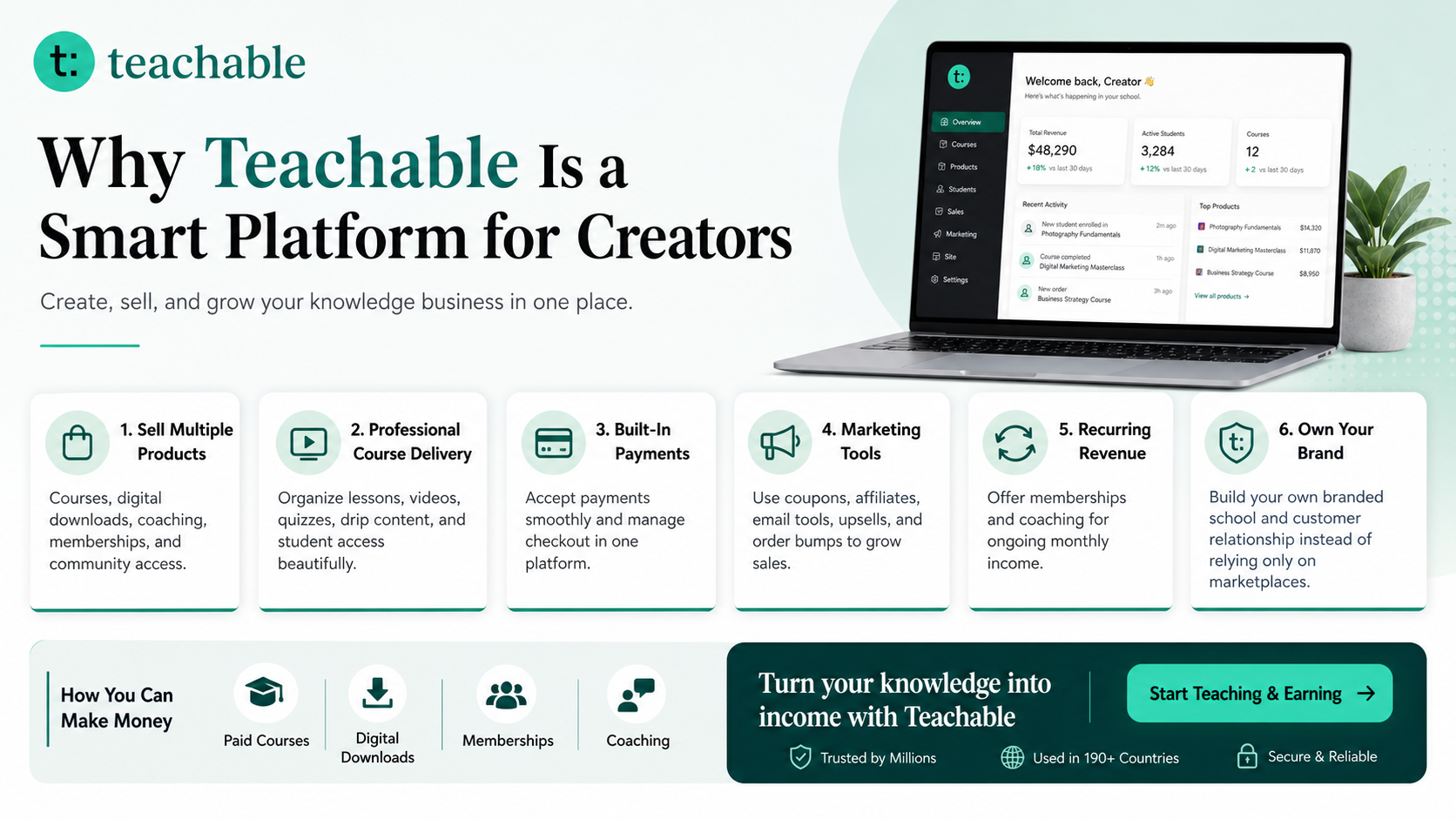
Teachable is an online platform that lets creators build, market, and sell courses, digital downloads, coaching, and memberships. It helps educators and entrepreneurs turn their knowledge into a branded digital business without needing complex coding.
Learn more on SenseCentral: How to Make Money with Teachable: A Complete Creator’s Guide
FAQs About What Is Benchmark in Mutual Funds
Is what is benchmark in mutual funds important for beginners?
Yes. What Is Benchmark in Mutual Funds is important because it helps beginners connect a mutual fund choice with cost, risk, time horizon, or goal suitability. It should not be used alone, but it is a useful part of a fund-selection checklist.
Where can I check what is benchmark in mutual funds before investing?
Start with the scheme factsheet, Scheme Information Document, Key Information Memorandum, AMC website, AMFI resources, SEBI investor education pages, and your investment platform’s official data. Avoid relying only on social media screenshots.
Should I choose a mutual fund only because returns are high?
No. High recent returns can come from higher risk, a temporary market cycle, or category-specific momentum. Always compare risk, consistency, cost, benchmark performance, portfolio quality, and suitability for your goal.
How often should I review my mutual funds?
A simple review every six to twelve months is usually enough for long-term investors. Review earlier if your goal date changes, your income changes, the fund’s strategy changes, or the fund begins to underperform its category and benchmark consistently.
Is this article financial advice?
No. This article is for education only. Mutual fund investments are subject to market risks, and investors should read all scheme-related documents carefully or consult a qualified financial adviser before investing.
Key Takeaways
- What Is Benchmark in Mutual Funds should be understood in the context of your goal, time horizon, and risk comfort.
- Do not select a mutual fund only from recent returns, ratings, or influencer recommendations.
- Compare funds within the same category and check cost, riskometer, benchmark, portfolio, and consistency.
- Use direct official sources such as AMC documents, AMFI, and SEBI investor pages for verification.
- Keep the portfolio simple; clarity is more useful than owning too many overlapping funds.
References and Useful External Links
- AMFI Investor Knowledge Center
- AMFI Direct Plan Guide
- AMFI Types of Mutual Fund Schemes
- AMFI Scheme Categorization
- SEBI Investor Riskometer Guide
- SEBI Investor Exit Load Guide
- AMFI Cut-off Timings and Applicable NAV
This article is educational and should be verified with current scheme documents, tax rules, and official sources before making investment decisions.