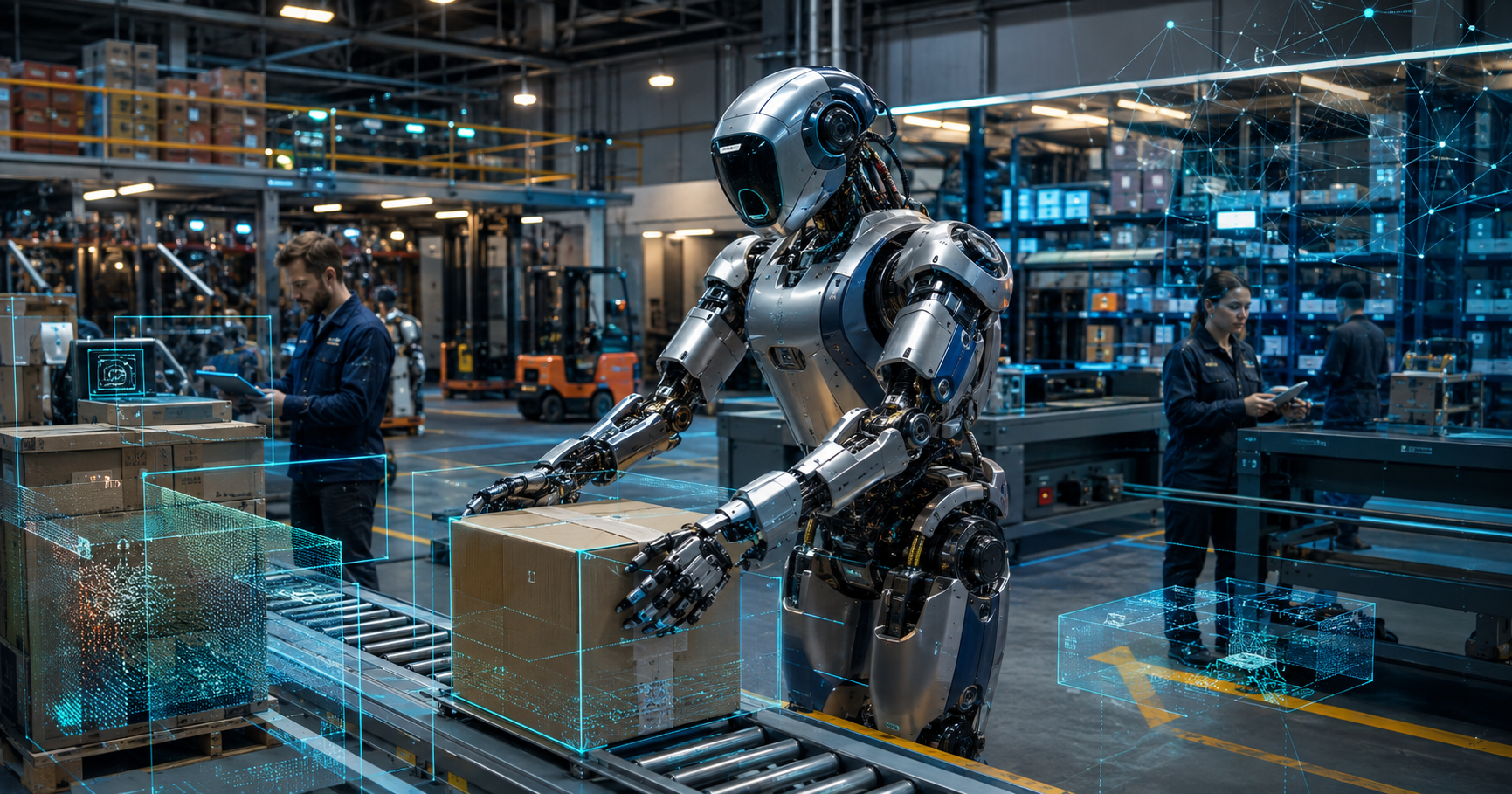
Humanoid Robots and Physical AI: How Intelligent Machines Are Entering the Physical World
Artificial intelligence has largely been experienced through screens. People interact with chatbots, recommendation systems, search engines, image generators and business software, but the AI itself usually remains inside a computer or cloud platform. Humanoid robots and physical AI represent a significant expansion of this idea. Instead of only processing information, AI-powered robots can perceive physical spaces, move through them, handle objects and interact with people.
- Table of Contents
- What Is a Humanoid Robot?
- What Is Physical AI or Embodied AI?
- Why Humanoid Form Factors Are Attracting Attention
- Core Technologies Behind Humanoid Robots
- Computer Vision
- Sensors
- Foundation Models
- Reinforcement Learning
- Motion Planning and Control
- Actuators
- Robotic Hands
- Human-Robot Interaction
- How Robots Perceive and Understand Their Surroundings
- Movement, Balance and Robotic Manipulation
- Training Robots Using Simulation and Real-World Data
- Current and Emerging Applications
- Humanoid Robots in Manufacturing
- Warehousing, Logistics and Retail
- Healthcare, Hospitality and Home Assistance
- Humanoid Robots, Industrial Arms, Mobile Robots and Service Robots Compared
- Benefits of Humanoid Robots
- Compatibility with Existing Environments
- Multi-Task Potential
- Support for Dangerous Work
- Continuous and Consistent Operation
- Response to Labour Constraints
- Better Physical Data
- Technical and Commercial Challenges
- Major Barriers to Mass Adoption
- Hardware Cost
- Battery Life
- Reliability
- Dexterity
- Safety Certification
- Maintenance
- Data Requirements
- Public Acceptance
- Safety, Ethics and Employment Concerns
- Humanoid Robots Versus Specialised Robots
- Future Outlook for Humanoid Robots and Physical AI
- Frequently Asked Questions
- 1. What is the difference between physical AI and humanoid robots?
- 2. Why do humanoid robots often have two arms and two legs?
- 3. Can humanoid robots understand natural-language instructions?
- 4. Are humanoid robots safe to work around?
- 5. When will humanoid robots become common in homes?
- Conclusion: The Responsible Future of Humanoid Robots
This transition from digital intelligence to physical capability is sometimes described as physical AI or embodied AI. It combines artificial intelligence with mechanical engineering, electronics, control systems, sensors and robotics. The goal is not simply to create machines that look like people. It is to develop intelligent robots that can understand their surroundings, make decisions and safely perform useful physical actions.
Humanoid robots are attracting particular attention because most homes, offices, factories, shops and public facilities were designed around the human body. Doors, stairs, shelves, tools, workstations and vehicles generally assume a person with two arms, two legs, hands and human-scale reach. A robot with a similar form could potentially operate in these environments without requiring every building or process to be redesigned.
However, the humanoid form is not automatically the best solution. Specialised robotic automation may remain cheaper, faster, more reliable and safer for many clearly defined tasks. Understanding the future of robotics therefore requires a balanced examination of both the opportunities and the limitations of humanoid machines.
What Is a Humanoid Robot?
A humanoid robot is a robotic system designed with some of the physical characteristics or functional abilities of a human body. A complete humanoid may have a torso, head, two arms, two hands and two legs. Other designs use a human-like upper body mounted on wheels or another mobile platform.
The definition does not require a robot to have a realistic human face or appearance. A machine can be considered humanoid because of its structure and capabilities rather than its cosmetic design. For example, an industrial humanoid may have a simple sensor unit instead of a face and mechanical grippers instead of realistic fingers.
Most humanoid robots contain several interconnected systems:
- A mechanical structure that supports the robot and protects its components.
- Electric, hydraulic or other types of actuators that create movement.
- Sensors that measure the robot’s surroundings and internal condition.
- Computers that process information and run AI models.
- Control software that coordinates balance, navigation and manipulation.
- Power systems, usually batteries, that provide energy for movement and computation.
- Communication systems for connecting with operators, cloud services or other machines.
A humanoid robot may be remotely operated, partially autonomous or highly autonomous. Autonomy can also vary by task. A robot might navigate independently but require human approval before lifting an unfamiliar object or entering a restricted area.
What Is Physical AI or Embodied AI?
Physical AI refers to artificial intelligence that can perceive, reason and act within the physical world. Embodied AI is a closely related term that emphasises how intelligence develops or operates through interaction between an AI system, its body and its environment.
A conventional AI application may classify an image, generate a document or answer a question. An embodied AI system must connect understanding with physical action. It may need to identify an object, estimate its position, plan how to reach it, move without colliding with anything, grip it with suitable force and place it in the correct location.
This combination is much harder than producing a digital response. Physical environments are continuously changing, and actions have real consequences. Objects can slip, people can move unexpectedly, floors can be uneven and sensor readings can be incomplete. Research into embodied AI therefore combines perception, learning, reasoning, planning and low-level control rather than treating them as isolated capabilities.
Physical AI is not limited to humanoid robots. Autonomous vehicles, delivery robots, agricultural robots, drones and intelligent industrial machinery can also be considered physical AI systems. Humanoids are one important category within this wider field.
Why Humanoid Form Factors Are Attracting Attention
The main argument for humanoid robots is environmental compatibility. Human infrastructure contains stairs, narrow passages, door handles, control panels, ladders, shelves and tools that were designed for human proportions and movement.
A humanoid robot could theoretically use the same workstations, equipment and protective systems already used by employees. This may allow an organisation to introduce robotic automation without completely rebuilding a facility.
The form factor may be especially valuable when work involves many different physical activities rather than a single repetitive motion. A humanoid could potentially move between locations, carry containers, operate basic controls, inspect equipment and use tools during the same work period.
Human-like structure may also make certain interactions easier to understand. People can often predict where a robot is looking, reaching or walking when its movements resemble familiar human actions. Nevertheless, human-like movement can also create unrealistic expectations. A robot that looks capable may still have limited perception, strength, battery life or decision-making ability.
The most useful robot is not necessarily the machine that looks most human. It is the machine that solves a physical problem safely, reliably and economically.
Core Technologies Behind Humanoid Robots
Humanoid robotics brings together several technical fields. Improvements in one area are rarely sufficient on their own. A capable machine requires progress across hardware, software, AI and systems engineering.
Computer Vision
Computer vision enables a robot to interpret images and video from cameras. It can help identify people, tools, packages, obstacles, doors, work surfaces and other objects. Vision systems may also estimate depth, recognise gestures, inspect components and track moving objects.
Sensors
Humanoid robots use multiple types of sensors to understand both the environment and their own condition. These may include:
- Colour and depth cameras for visual perception.
- Distance sensors for obstacle detection and mapping.
- Inertial measurement units for orientation and motion.
- Joint encoders for measuring limb positions.
- Force and torque sensors for detecting physical contact.
- Tactile sensors for measuring pressure across robotic hands.
- Microphones for speech and sound recognition.
- Temperature and electrical sensors for monitoring hardware health.
Foundation Models
Foundation models are AI models trained on broad datasets and adapted for multiple tasks. In robotics, multimodal foundation models may process language, images, video, spatial information and actions. They can help a robot interpret natural-language instructions, identify relevant objects, break goals into steps and select possible actions.
Foundation models do not replace traditional robotics systems. A language model might interpret the instruction “move the empty container beside the workstation,” but motion planners and control systems are still needed to execute the action accurately and safely. Current robotics research commonly explores how foundation models can support perception, planning, navigation, manipulation and reasoning while remaining connected to established control methods.
Reinforcement Learning
Reinforcement learning allows an AI system to improve behaviour by receiving feedback from its actions. A robot or simulated robot attempts a task and receives a reward when it moves closer to the desired outcome. Through many trials, it can learn strategies for walking, balancing, grasping or moving objects.
Because real robots are expensive and can be damaged during unsuccessful trials, much reinforcement learning takes place in simulation before policies are transferred to physical hardware.
Motion Planning and Control
Motion planning calculates how a robot should move from its current state to a desired state while respecting physical constraints. A planner may determine how the arm should travel around an obstacle or where the robot should place its feet while crossing a cluttered area.
Control systems then convert those plans into rapid motor commands. They continuously compare intended movement with sensor feedback and make corrections. This feedback loop is essential because physical systems rarely move exactly as mathematical models predict.
Actuators
Actuators function like a robot’s muscles. They convert electrical, hydraulic or pneumatic energy into movement. Humanoid robots need compact actuators that provide sufficient force while remaining efficient, responsive and controllable.
The design involves difficult trade-offs. Stronger actuators may be heavier and consume more power, while lighter mechanisms may have limited lifting capacity or durability.
Robotic Hands
Human hands can perform both powerful and delicate tasks, from carrying a box to inserting a small connector. Reproducing this versatility is extremely difficult.
Robotic hands may use several articulated fingers, tactile sensors and force-control mechanisms. Simpler grippers are often more reliable, but human-like hands may be needed when robots must use existing tools or manipulate objects with varied shapes.
Human-Robot Interaction
Human-robot interaction covers communication, collaboration, trust, usability and safety between people and robots. Interaction may involve speech, screens, gestures, lights, sounds or direct physical cooperation.
Researchers and standards organisations examine how robot behaviour can be measured and communicated so that people understand what a machine is doing and how to respond. NIST’s human-robot interaction work, for example, highlights the need for datasets, metrics, test methods and system models that evaluate interfaces, trust, safety and situational awareness.
How Robots Perceive and Understand Their Surroundings
A robot does not experience the world exactly as a person does. It receives streams of measurements from cameras, microphones, distance sensors, joint sensors and other devices. AI and perception software must transform these measurements into an internal representation of the environment.
This process often begins with sensor fusion. Information from several sensors is combined because each source has limitations. A camera may provide rich visual detail but perform poorly in low light. A depth sensor may estimate distance but provide less information about colour or texture. Combining them can produce a more dependable result.
The robot may create a map showing walls, objects, work zones and possible travel paths. It must also estimate its own location within that map. For manipulation, the system needs more detailed information, including an object’s position, orientation, shape and possible grasping points.
Understanding context is equally important. A robot should distinguish between an object that can be moved and a fixed structure, recognise that a person has entered its path and understand that a fragile container requires different handling from a metal component.
Uncertainty must always be considered. When confidence is low, a well-designed robot should slow down, gather more information, ask for assistance or stop instead of confidently taking an unsafe action.
Movement, Balance and Robotic Manipulation
Walking on two legs requires constant balance adjustments. The robot must control its centre of mass, calculate foot placement and react to changes in the floor or external forces. Even standing still involves continuous control.
Wheeled robots usually have simpler balance requirements and can be more energy-efficient on smooth floors. Bipedal movement becomes valuable when the environment contains stairs, steps, narrow passages or obstacles that cannot easily be crossed by wheels.
Manipulation adds another level of complexity. The robot must coordinate its shoulders, arms, wrists, hands and body position. A task such as lifting a container may involve estimating weight, choosing a grip, applying enough force to prevent slipping and adjusting posture to remain balanced.
Contact-rich activities are particularly challenging. Turning a stiff handle, connecting a cable, folding material or using a handheld tool requires precise force control. Small errors in position can create large forces or damage an object.
Effective manipulation therefore depends on both planning and feedback. The robot should continuously measure contact forces and revise its movement rather than blindly following a fixed path.
Training Robots Using Simulation and Real-World Data
Robots need experience to operate effectively, but collecting large quantities of physical experience is costly. Real-world training can consume energy, require human supervision, damage hardware and create safety risks.
Simulation provides a controlled environment in which developers can generate many training scenarios. A virtual robot can practise walking, lifting, grasping and navigation without physically wearing out motors or breaking objects.
A digital twin is a virtual representation of a physical machine, facility or process. Developers can use digital twins to test robot behaviour inside a model of a warehouse, factory or building before deployment. Variables such as lighting, object positions, floor friction and equipment layout can be changed to expose the AI to varied conditions.
Research into embodied intelligence increasingly uses physical simulators and world models to expand training and evaluate possible actions. However, transferring a behaviour from simulation to reality remains difficult because virtual physics and sensor models cannot perfectly reproduce the physical world.
Real-world data is therefore still necessary. It may be collected through:
- Human operators remotely controlling robots.
- People demonstrating tasks through motion-tracking equipment.
- Robots repeating supervised actions.
- Video and sensor recordings from actual workplaces.
- Feedback from failed or partially successful attempts.
- Synthetic data produced in simulation.
A practical training process may begin with simulation, continue with supervised real-world trials and gradually allow greater autonomy after the robot demonstrates acceptable performance.
Current and Emerging Applications
Humanoid robots are being explored for tasks that are repetitive, physically demanding, ergonomically difficult or performed in environments built for people. Early applications are more likely to involve structured workplaces than completely unpredictable homes or public spaces.
Potential tasks include moving materials, loading machines, sorting objects, inspecting equipment, carrying supplies and assisting workers with routine activities. Robots may initially work in limited zones with clearly defined procedures, human supervision and the ability to request help.
The most realistic near-term use cases are not necessarily fully autonomous general-purpose robots. They may involve machines that perform a small collection of useful tasks reliably, with remote assistance available for unusual situations.
Humanoid Robots in Manufacturing
Manufacturing is a major area of interest for humanoid robotic automation because factories contain structured processes, repeatable workflows and measurable production goals.
A humanoid robot could potentially perform material-handling tasks such as:
- Moving parts between workstations.
- Loading and unloading production equipment.
- Carrying containers or tools.
- Performing visual inspections.
- Organising components for human workers.
- Supporting packaging and assembly processes.
The humanoid design may be useful when the facility cannot easily accommodate fixed automation or when the same robot must work at several human-scale stations.
Nevertheless, manufacturing demands high reliability. A robot that succeeds most of the time but frequently stops for assistance may not deliver a strong commercial return. NIST identifies adaptability, safe human collaboration, easy task assignment and rapid integration as continuing challenges for advanced manufacturing robotics.
Warehousing, Logistics and Retail
Warehouses combine transportation, picking, sorting, packing and inventory activities. Autonomous mobile robots already move goods through many structured facilities, while humanoids could add the ability to handle objects and operate human-designed equipment.
Possible tasks include moving containers between shelves, unloading lightweight items, preparing orders and restocking work areas. A humanoid might also operate alongside existing conveyors, carts and storage systems.
Retail environments are more complex because customers move unpredictably and products vary widely. Intelligent robots might eventually assist with shelf scanning, stock checks, simple restocking or transporting goods behind the scenes. Customer-facing use would require careful interaction design, privacy protection and clear human supervision.
For high-volume movement across smooth floors, an autonomous mobile robot may remain more efficient than a walking humanoid. The humanoid becomes more attractive when transportation must be combined with reaching, grasping or operating equipment.
Healthcare, Hospitality and Home Assistance
Healthcare and home assistance are frequently discussed applications, but they also involve some of the highest safety and reliability requirements.
Robots could support staff by transporting supplies, carrying laundry, delivering meals or performing routine environmental checks. These supporting tasks may reduce physical workload without requiring the robot to make medical decisions.
Hospitality robots might deliver items, move luggage, support cleaning teams or provide basic directions. However, crowded environments, children, pets, stairs and unexpected human behaviour make these applications challenging.
Home assistance is even more demanding because every home is different. Objects are unstructured, spaces may be cluttered and users may need highly personalised support. A robot intended to assist older adults or people with disabilities must be designed around dignity, consent, privacy and dependable emergency behaviour.
These sectors may initially use robots for narrow support functions rather than complete replacement of caregivers, healthcare workers or hospitality staff.
Humanoid Robots, Industrial Arms, Mobile Robots and Service Robots Compared
| Robot Type | Design | Mobility | Flexibility | Best Applications | Advantages | Limitations |
|---|---|---|---|---|---|---|
| Humanoid robots | Human-like torso, arms, hands and often two legs | Potentially able to walk through human environments and use stairs | Designed for multiple human-scale tasks | Material handling, inspection, machine operation and mixed physical workflows | Can potentially use human tools, workstations and infrastructure | High cost, difficult balance control, limited battery life and complex maintenance |
| Industrial robotic arms | Fixed or mounted articulated arm | Usually stationary | Highly flexible within a defined workspace but limited outside it | Welding, painting, assembly, machining and repetitive manipulation | Fast, precise, mature and reliable for structured tasks | Requires fixed installation, guarding and process-specific integration |
| Autonomous mobile robots | Wheeled mobile base, sometimes with shelves or containers | Efficient movement across suitable floors | Flexible for transportation but may have limited manipulation | Warehouse transport, hospital delivery and internal logistics | Energy-efficient, stable and commercially practical for movement | May struggle with stairs, uneven terrain and object handling |
| Service robots | Application-specific body, often combining wheels, screens and simple arms | Varies by design | Usually optimised for a limited service function | Cleaning, delivery, guidance, inspection and customer support | Can be designed around a clearly defined use case | Limited ability to adapt beyond its intended service |
Benefits of Humanoid Robots
Humanoid robots could provide several advantages when applied to suitable tasks.
Compatibility with Existing Environments
A human-scale robot may use existing doors, workstations, shelves, tools and pathways. This could reduce the need to redesign an entire workplace around automation.
Multi-Task Potential
Instead of installing a separate machine for every process, an organisation might use one mobile robot for several related activities. The commercial value would depend on how quickly and reliably the robot can switch between tasks.
Support for Dangerous Work
Robots may reduce human exposure to extreme heat, hazardous materials, unstable structures, heavy loads or repetitive strain. Human oversight would remain necessary, especially in unpredictable environments.
Continuous and Consistent Operation
Robots can perform repeatable procedures without fatigue, although they still require charging, inspection, maintenance and software monitoring.
Response to Labour Constraints
In areas where employers have difficulty filling physically demanding or repetitive roles, robotic assistance may supplement available workers. Adoption should focus on improving the overall work system rather than assuming that every human role can or should be removed.
Better Physical Data
Robots can record information about equipment, inventory, environmental conditions and process performance. When governed responsibly, this information may support maintenance, quality control and operational planning.
Technical and Commercial Challenges
Building a robot demonstration is different from operating a dependable commercial system. A robot must work across thousands of repeated cycles, handle variations, recover from errors and remain economical over its full life.
Mechanical systems experience wear. Sensors become dirty or misaligned. Batteries degrade. Software updates can introduce unexpected behaviour. Even small changes to lighting, floor conditions or object packaging may reduce performance.
Businesses must evaluate the complete cost of ownership, including:
- Initial robot purchase or subscription cost.
- Facility assessment and integration.
- Safety equipment and certification.
- Employee training.
- Maintenance and replacement parts.
- Software licences and connectivity.
- Charging infrastructure.
- Remote supervision and technical support.
- Cybersecurity and data governance.
- Downtime when the robot cannot complete a task.
A successful business case requires more than an impressive demonstration. The robot must produce measurable value while meeting safety, quality and reliability requirements.
Major Barriers to Mass Adoption
Hardware Cost
Humanoid robots contain many motors, sensors, computers, structural components and precision parts. Producing, repairing and replacing these components can be expensive. Costs may decrease with manufacturing scale, but the robot must still deliver enough value to justify its purchase and operation.
Battery Life
Walking, balancing, lifting and running AI models consume significant energy. Larger batteries increase operating time but also add weight. Charging time and battery replacement must be considered when planning continuous operations.
Reliability
Commercial users need predictable performance. A robot that frequently falls, drops objects, overheats or requires human intervention may create more disruption than value.
Dexterity
Robotic hands still struggle with many everyday objects. Transparent, soft, reflective, flexible or irregularly shaped items can be difficult to recognise and grip. Tasks involving cables, fabric, packaging or small components require especially advanced dexterity.
Safety Certification
Robots operating near people must undergo structured risk assessment, testing and validation. Safety cannot depend only on an AI model making the correct decision. Mechanical limits, emergency stops, safe speeds, protective zones and fault-detection systems are also required.
International standards address the safe design and integration of industrial and service robots. The ISO 10218 series covers industrial robot safety, while service-robot standards consider hazards and physical human-robot contact in personal and professional applications.
Maintenance
A humanoid has many moving joints and complex components. Organisations will need trained technicians, spare parts, diagnostic tools and maintenance schedules. Maintenance requirements may become a major operating expense.
Data Requirements
Intelligent robots require varied training and testing data. Data must represent different objects, layouts, people, lighting conditions and failure scenarios. Collecting real-world robotic data is usually slower and more expensive than collecting text or images for software-based AI.
Public Acceptance
People may have concerns about privacy, safety, surveillance, job security or discomfort around human-like machines. Organisations must clearly communicate what robots can do, what information they collect and how human control is maintained.
Safety, Ethics and Employment Concerns
A software error may produce an incorrect digital result. A robotics error can create physical harm. Physical AI systems therefore require layered safety mechanisms rather than relying entirely on machine learning.
Important protections include controlled operating zones, speed limits, force limits, collision detection, emergency stopping, secure access controls, activity logs and human override procedures.
Privacy is another concern. Robots may carry cameras and microphones through workplaces, healthcare facilities or homes. Data collection should be limited to what is genuinely necessary, protected from unauthorised access and governed by clear retention policies.
Responsibility must also be defined. Organisations need procedures for determining who approves a robot’s tasks, who responds to failures and who is accountable for maintenance, software configuration and safety monitoring.
Will Humanoid Robots Replace Jobs?
Humanoid robots may automate certain tasks, particularly those that are repetitive, physically demanding or performed in controlled environments. This does not mean that every occupation containing those tasks will disappear.
Most jobs contain a mixture of physical work, communication, judgement, problem-solving and responsibility. A robot may automate material movement while employees continue managing exceptions, serving customers, inspecting quality or coordinating operations.
Robotics adoption may also create or expand roles in:
- Robot maintenance and field service.
- Robotics integration and facility design.
- Remote operation and supervision.
- Safety assessment and compliance.
- AI and robotics software development.
- Data collection and model evaluation.
- Cybersecurity and systems monitoring.
- Employee training and process redesign.
The employment impact will vary by industry, region and implementation strategy. Responsible adoption should include workforce consultation, training opportunities and clear plans for employees whose tasks are changing.
Humanoid Robots Versus Specialised Robots
Humanoid robots offer generality, but generality introduces complexity. A machine designed to walk, balance, lift, reach and use tools requires more hardware and software than a fixed robotic arm designed for one workstation.
Specialised machines may remain the better option when a task is repetitive, high-speed and predictable. An industrial arm can perform the same movement rapidly without carrying batteries or balancing on legs. A conveyor can transport thousands of items without needing visual navigation. A cleaning robot can be shaped around the floor rather than around the human body.
Specialised robots may be preferable because they can be:
- Cheaper to manufacture and maintain.
- Faster at a narrowly defined task.
- Easier to validate and certify.
- More stable and energy-efficient.
- Protected by established safety systems.
- Integrated into predictable production processes.
Humanoid robots are more compelling when tasks are diverse, the environment changes, human tools must be used or infrastructure cannot easily be modified. Even then, a wheeled base with robotic arms may sometimes be more practical than two-legged movement.
The future of robotics is therefore unlikely to involve humanoids replacing every other type of machine. Instead, factories, warehouses, hospitals, shops and homes may use combinations of specialised robots, mobile platforms, intelligent equipment and humanoid systems.
Future Outlook for Humanoid Robots and Physical AI
The development of humanoid robots will depend on steady improvement rather than a single breakthrough. Better batteries, lighter materials, efficient actuators, tactile sensing, simulation tools and robotics foundation models could gradually increase capability and reduce cost.
Near-term progress is likely to focus on structured commercial settings where tasks can be clearly defined and human support is available. Robots may begin with repetitive material-handling assignments and gain additional skills through software updates, new training data and improved hardware.
Remote assistance may remain an important part of deployment. When a robot encounters an unfamiliar situation, a human operator could guide it, resolve the problem and provide a new example for future training. This approach combines automation with human judgement instead of demanding complete autonomy from the beginning.
Developers are also likely to build better evaluation systems. Physical AI must be tested not only for average task success but also for failure recovery, safe behaviour, contact forces, reliability and performance around people. Measurement science and repeatable testing will be essential for confidently applying autonomous systems in real-world environments.
Over time, organisations may treat robotic skills more like software capabilities. A robot could receive validated packages for inspection, handling or machine operation. However, every skill would still need to be tested on the robot’s specific hardware and in the intended environment.
The most successful physical AI systems may not be the machines that imitate every human ability. They may be robots that combine a practical body, dependable intelligence and carefully defined responsibilities.
Frequently Asked Questions
1. What is the difference between physical AI and humanoid robots?
Physical AI is the broader concept of artificial intelligence that perceives and acts in the physical world. A humanoid robot is one possible physical form for such an AI system. Drones, autonomous vehicles and agricultural robots can also use physical AI without being humanoid.
2. Why do humanoid robots often have two arms and two legs?
Two arms allow robots to reach, carry and manipulate objects in ways that resemble human work. Two legs may help them use stairs and navigate buildings designed for people. However, wheels may be more efficient when a robot only needs to travel across smooth floors.
3. Can humanoid robots understand natural-language instructions?
AI models can help robots interpret spoken or written instructions, but language understanding is only one part of the process. The robot must still connect words to objects, locations, physical constraints, motion plans and safety rules.
4. Are humanoid robots safe to work around?
Safety depends on the robot, application, environment and integration process. Robots working near people require risk assessments, mechanical safety features, controlled motion, monitoring, emergency procedures and appropriate certification. No robot should be assumed safe solely because it uses advanced AI.
5. When will humanoid robots become common in homes?
There is no dependable universal timeline. Homes are highly varied and contain unpredictable situations, making domestic robotics difficult. Commercial environments with structured tasks, trained staff and controlled layouts are likely to support wider adoption earlier than general-purpose home use.
Conclusion: The Responsible Future of Humanoid Robots
Humanoid robots are an ambitious attempt to bring artificial intelligence into the physical environments where people live and work. By combining computer vision, sensors, foundation models, reinforcement learning, motion planning, actuators, robotic hands and human-robot interaction, these machines may eventually perform a range of useful physical tasks.
The humanoid form could be valuable in environments designed for people, especially when a robot must use existing tools, navigate human-scale spaces or move between different activities. At the same time, specialised machines will remain cheaper, faster and safer for many repetitive or highly structured processes.
The future of robotics will not be determined by appearance alone. Successful adoption will depend on reliability, safety, economics, maintenance, workforce planning and the ability to solve genuine operational problems. Physical AI should be introduced with realistic expectations, strong human oversight and careful evaluation of both benefits and risks.
As intelligent robots move from laboratories and demonstrations into workplaces and public environments, businesses and communities should ask a practical question: Which physical tasks would genuinely benefit from intelligent robotic assistance, and which tasks are still better performed by people or specialised machines?