
Updated for context as of January 2026.
- Key Takeaways
- Table of Contents
- What Exactly Was Announced?
- What Is Freestyle Chess (Chess960) and Why Is It Trending?
- Why the FIDE vs. Freestyle Feud Mattered
- The New Championship Format: Players, Qualification, and Schedule
- Where and when?
- Prize fund
- Who plays?
- Time control and match structure
- Women’s events
- A notable absence: Hikaru Nakamura
- How This Could Reshape Elite Chess
- 1) It upgrades Chess960 from “variant” to “pillar”
- 2) It changes what “best in the world” can mean
- 3) It’s built for streaming and modern audiences
- 4) It reduces the “opening arms race”
- 5) It may become a model for private-public cooperation in chess
- Criticisms, Risks, and the “Too Many Titles” Problem
- 1) Title inflation: When everything is a world championship, nothing is
- 2) Format concerns: Is three days enough for a world title?
- 3) Governance tension doesn’t vanish overnight
- What to Watch Next
- 1) The online qualifier (and who grabs the final slot)
- 2) Women’s Freestyle Championship development
- 3) Integration into the broader ecosystem
- 4) The “identity” of Freestyle chess: sport or entertainment?
- FAQs
- Is Freestyle Chess the same as Chess960?
- Why is FIDE’s approval so important?
- When and where is the 2026 Freestyle World Championship?
- How do players qualify?
- What’s the prize money?
- Does this replace the classical World Championship?
- Why did some top players criticize it?
- References & Further Reading
For most of modern chess history, “world championship” has meant one thing: the classical crown governed by FIDE (the International Chess Federation). But the elite calendar is changing fast—and now a long-simmering dispute between FIDE and the fast-rising “Freestyle Chess” movement has turned into something chess fans rarely see: a signed peace deal, a shared framework, and a brand-new official world title.
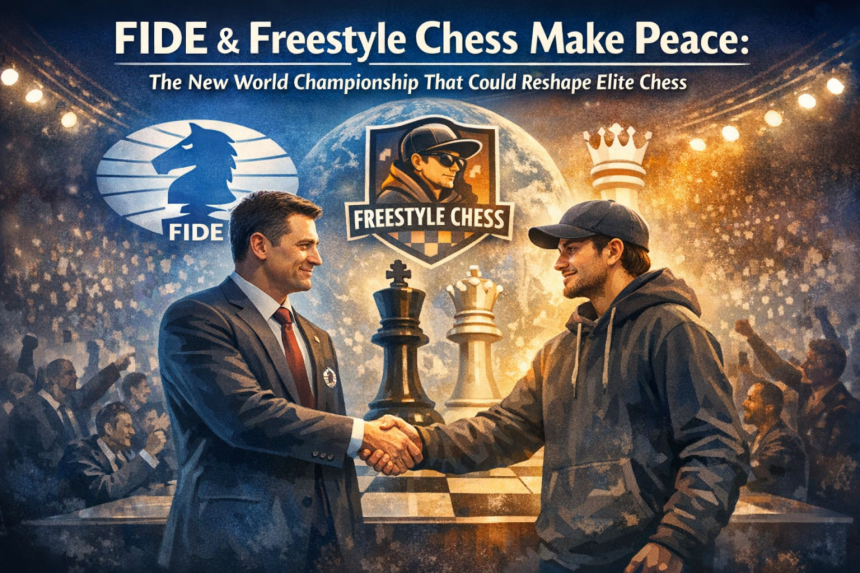
On January 7, 2026, FIDE and Freestyle Chess Operations announced a cooperation agreement that green-lights the first official FIDE Freestyle Chess World Championship—a top-tier world championship in Freestyle Chess, also known as Chess960 or Fischer Random. The event is set for February 13–15, 2026 in Weissenhaus, Germany, with a $300,000 prize pool and a compact, made-for-broadcast format built around rapid time controls.
If you’re wondering why this matters, here’s the simple answer: it’s not just “another tournament.” It’s a governance signal, a commercial blueprint, and a strategic bet that elite chess can thrive when creativity replaces memorized opening files.
Key Takeaways
- FIDE and Freestyle Chess have signed a cooperation agreement, meaning the title is officially sanctioned under FIDE’s framework.
- The inaugural FIDE Freestyle Chess World Championship runs Feb 13–15, 2026 at Weissenhaus, Germany, with a $300,000 prize pool.
- Eight-player field: six qualifiers from the 2025 Freestyle Grand Slam Tour, one Freestyle nomination, and one FIDE online qualifier.
- Freestyle (Chess960) reduces opening memorization by randomizing the back-rank setup—testing calculation, adaptability, and real-time skill.
- This “peace deal” could reshape elite chess: new broadcast-friendly formats, more world titles, and renewed debates about what “world champion” should mean.
What Exactly Was Announced?
The headline is straightforward: FIDE and Freestyle Chess agreed to jointly stage an official world championship in Freestyle Chess. According to FIDE’s announcement, the championship will be governed by FIDE in collaboration with Freestyle Chess, and the two organizations signed a cooperation agreement on January 7, 2026. Importantly, the agreement reinforces a central point in chess governance: no event can be marketed as an official “World Chess Championship” without FIDE’s written consent.
The event will take place at Weissenhaus, Germany from February 13–15, 2026, with a $300,000 prize fund and $100,000 for the champion. It is being framed as a continuation of FIDE’s earlier Fischer Random (Chess960) initiatives, with previous official championships held in 2019 and 2022.
For fans, the practical implication is huge: a format once treated like a side-quest—fun, chaotic, creative—now gets a formal, titled “world championship” lane with FIDE’s stamp on it.
External links (official + coverage):
- FIDE announcement: The first official FIDE Freestyle Chess World Championship
- Reuters: FIDE and Freestyle Chess agree on $300,000 event
- Chess.com: Freestyle Chess partners with FIDE to stage official World Championship
What Is Freestyle Chess (Chess960) and Why Is It Trending?
Freestyle Chess is essentially Chess960—a chess variant designed to attack the biggest “solved” feeling in elite chess: opening preparation. Instead of starting from the standard arrangement (rooks in the corners, knights next, bishops, queen, king), the back rank is randomized under a few constraints:
- The king starts somewhere between the two rooks.
- The two bishops must start on opposite-colored squares.
- Black mirrors White’s starting setup.
The result: 960 possible starting positions—hence the name. The big strategic change is that your “book” knowledge becomes less valuable, and your ability to calculate, coordinate pieces, and adapt becomes more valuable.
This is why the format fits the modern moment. Fans increasingly want:
- Less repetition (fewer identical openings across dozens of games).
- More creativity (new structures from move one).
- More action (faster time controls + unfamiliar positions = more decisive mistakes and brilliancies).
Even the rules around castling—often confusing to newcomers—are standardized by FIDE’s Chess960 rules so that after castling, the king and rook end up on the same final squares as in classical chess (king on g-file for king-side castling, or c-file for queen-side castling), even if they started elsewhere.
External links (rules + explainers):
- Chess960 overview (background and history)
- FIDE Laws of Chess (includes Chess960 rules appendix)
- Chess.com guide: How to castle in Chess960
- Chess.com terms: What is Chess960?
- Play Chess960 on Lichess (variant page)
Why the FIDE vs. Freestyle Feud Mattered
To understand why people are calling this “peace,” you need the backdrop: the fight wasn’t really about a single tournament—it was about the right to define “world championship.”
Freestyle Chess rose quickly as a premium product: elite players, strong production, a brand built around the promise that modern chess should feel less like memorizing 30 moves of theory and more like solving fresh problems live. But FIDE has a core institutional interest: protecting the legitimacy of world titles. If any private organizer can label a tournament a “world championship,” the word starts to lose meaning.
In early 2025, FIDE publicly addressed the Freestyle project and emphasized scheduling and regulatory concerns, while also indicating a willingness to accommodate events under certain conditions. That statement became a reference point in the wider debate about player commitments, governance, and whether the chess world was heading toward a “splintered titles” era.
The January 2026 agreement effectively draws a line under the dispute: Freestyle gets the legitimacy and infrastructure of the official chess ecosystem; FIDE gets title control, standardization, and a new format under its governance umbrella.
External links (context):
- FIDE statement (2025) regarding the Freestyle Chess project
- ChessBase interview: “Friends again” — inside the turnaround
The New Championship Format: Players, Qualification, and Schedule
Where and when?
The inaugural official championship is scheduled for February 13–15, 2026 in Weissenhaus, Germany. The short, three-day structure is intentional: it’s built for a modern media cycle—tight schedule, high stakes, high visibility.
Prize fund
The total prize pool is $300,000, with $100,000 to the champion—serious money for a compact event, and a clear signal that this is intended to be top-tier, not “exhibition.”
Who plays?
The field is eight players. Six qualified based on results in the 2025 Freestyle Chess Grand Slam Tour:
- Magnus Carlsen
- Levon Aronian
- Fabiano Caruana
- Vincent Keymer
- Arjun Erigaisi
- Javokhir Sindarov
Two additional spots are filled separately:
- Freestyle nomination: Hans Niemann (already named by the organizer).
- FIDE spot: an online qualification tournament hosted on Chess.com (announced for mid-January 2026) to determine the final participant.
This matters because qualification structures decide legitimacy. A title that includes a pathway—even a limited one—feels more “sporting” than a pure invite-only showcase.
Time control and match structure
The championship is expected to use rapid time controls and culminate in a four-game final. That means less room to “grind” like classical chess and more emphasis on nerve, intuition, and quick calculation in unfamiliar positions.
Women’s events
Alongside the main event, a Women’s Exhibition Match is planned in Weissenhaus. Beyond that, the parties also announced an inaugural FIDE Women’s Freestyle Chess Championship planned for later in 2026 with a $50,000 prize fund.
External links (players + qualifier):
- Chess.com: Official play-in / qualifier announcement
- Chess.com: Partnership details + player reactions
- FIDE: Official event details + quotes from Dvorkovich and Buettner
A notable absence: Hikaru Nakamura
One of the biggest conversation points is who isn’t playing. Hikaru Nakamura—widely associated with elite rapid chess and a major voice in modern chess media—declined participation, publicly framing the event as rushed and expressing dissatisfaction with the change in structure and prize expectations.
Key point: Nakamura called it a “hastily arranged” event and declined his slot.
Whether you agree with him or not, the criticism highlights a real issue: if a world championship appears quickly, with limited lead time and shifting formats, players and fans will ask whether the title is being treated with enough gravity.
External link (reaction):
How This Could Reshape Elite Chess
1) It upgrades Chess960 from “variant” to “pillar”
For years, Chess960 lived in a strange middle ground: popular online, respected by many top players, but still not treated like a core championship track. Official sanctioning and a named world title elevates it. The format becomes a serious lane for legacy—something players can add to their historical record.
2) It changes what “best in the world” can mean
Classical chess rewards deep opening work, long-term preparation, and endgame grind. Freestyle rewards adaptability and creativity under uncertainty. If classical chess is a marathon, Freestyle is a high-stakes problem-solving sprint.
So the big question becomes: will the chess world start celebrating multiple “best” profiles?
- Classical champion: the peak of long-format competitive tradition.
- Rapid/Blitz champions: speed, technique, and practical decision-making.
- Freestyle champion: creativity-first dominance with minimal opening memory advantage.
This is both exciting and complicated. Exciting because it creates more storylines and matchups. Complicated because it can dilute the cultural meaning of “world champion” if titles multiply too quickly.
3) It’s built for streaming and modern audiences
A three-day, rapid-heavy world championship is easy to package: clear start, clear finish, constant tension, and a shorter attention demand from viewers. That’s not a small detail—modern sports economics often reward formats that fit broadcast windows and social media momentum.
4) It reduces the “opening arms race”
At the very top level, classical chess can feel like a preparation war—teams of seconds, engine labs, and memorized lines. Freestyle doesn’t remove preparation entirely (players still study typical piece coordination patterns), but it makes memorizing long forced sequences far less decisive.
That can be good for:
- Fans (more original positions and plans).
- Underdogs (less advantage from massive prep teams).
- Commentary (fresh ideas instead of repeating known theory).
5) It may become a model for private-public cooperation in chess
The bigger significance isn’t only the event itself—it’s the template:
- Private organizers can innovate with format, production, sponsorships, and venues.
- FIDE provides governance, legitimacy, and standardized rules.
If this model works, expect more “hybrid” championships and circuits—especially as the elite calendar expands beyond the classical crown.
External links (broader elite calendar context):
- Reuters: How this fits into the growing elite calendar
- The Guardian: Elite chess shifting landscape (mentions the Freestyle world title)
Criticisms, Risks, and the “Too Many Titles” Problem
1) Title inflation: When everything is a world championship, nothing is
This is the fear many traditionalists have. Chess already has world titles across classical, rapid, blitz, women’s categories, juniors, and more. Adding another top-tier title can be thrilling—but it can also confuse casual audiences.
If you’re new to chess and you hear:
- “World Champion”
- “Rapid World Champion”
- “Blitz World Champion”
- “Freestyle World Champion”
…you might reasonably ask: “Okay, but who is the champion?” That question is a branding challenge chess has wrestled with for decades.
2) Format concerns: Is three days enough for a world title?
A world championship traditionally implies a longer test: stamina, adaptation across many games, and a large sample size of positions. A short rapid event can crown a deserving winner—but it also increases variance. One bad day, one tactical hallucination, one time scramble blunder, and a title is gone.
Supporters will say: that’s the point—high stakes, high drama. Critics will say: a world title should be less volatile.
3) Governance tension doesn’t vanish overnight
“Peace” in chess politics often means “a truce with paperwork.” The deeper tension—who controls elite chess narratives, calendars, and commercial rights—will still exist. The difference now is that both sides have agreed to play inside the same legal and sporting framework.
What to Watch Next
1) The online qualifier (and who grabs the final slot)
The qualifier hosted on Chess.com is a crucial legitimacy lever. If the qualification path feels competitive and transparent, fans will be more willing to treat the champion as a true world champion in the format.
2) Women’s Freestyle Championship development
A women’s exhibition running alongside the main event is a visibility play, but the bigger story is the planned Women’s Freestyle Championship later in 2026 with a dedicated prize fund. Watch for details: qualification, format length, and whether it becomes a recurring annual title.
3) Integration into the broader ecosystem
Freestyle Chess has talked about building a serious circuit rather than isolated events. The championship will test whether a long-term tour can coexist with FIDE’s calendar without constant friction—and whether players will commit to it like they do to classical cycles.
4) The “identity” of Freestyle chess: sport or entertainment?
The best outcome is both: an entertaining product that still feels like real sport. If Freestyle becomes too show-like, it risks being dismissed as “content.” If it becomes too rigid, it loses the creativity that made it exciting.
FAQs
Is Freestyle Chess the same as Chess960?
Yes. “Freestyle Chess” is a modern branding of Chess960 (also called Fischer Random), where the starting back rank is randomized under specific rules.
Why is FIDE’s approval so important?
Because FIDE is the recognized world governing body of chess. The cooperation agreement reinforces that events cannot market themselves as an official “World Championship” without FIDE’s written consent.
When and where is the 2026 Freestyle World Championship?
It is scheduled for February 13–15, 2026 in Weissenhaus, Germany.
How do players qualify?
Six players qualified via results from the 2025 Freestyle Chess Grand Slam Tour. One spot is nominated by Freestyle Chess (Hans Niemann), and one spot comes from an online qualifier organized by FIDE on Chess.com.
What’s the prize money?
The total prize pool is $300,000, with $100,000 to the champion.
Does this replace the classical World Championship?
No. The classical World Championship remains its own track. This adds an official world title in a different format—Freestyle/Chess960.
Why did some top players criticize it?
Criticism centers on the short time frame, the compact rapid-only structure, and concerns about whether a three-day event is enough to crown a “world champion.” Some players also prefer longer, classical time controls in Freestyle to reduce variance.
References & Further Reading
- FIDE: The first official FIDE Freestyle Chess World Championship (Jan 7, 2026)
- Reuters: Another world title up for grabs (Jan 7, 2026)
- Chess.com: Partnership + details + reactions
- Chess.com: Announcing the play-in / online qualifier
- ChessBase: Interview on the FIDE–Freestyle turnaround
- FIDE: 2025 statement regarding Freestyle Chess
- FIDE Laws of Chess (Chess960 rules appendix)
- Chess960 (general background)
- The Guardian: Elite chess landscape and the new title mention
Disclosure: This article is an explanatory analysis of publicly reported announcements and does not represent official statements beyond the sources linked above.