Oil and/or gas are never alone in “saturating” the available pore space. Water is always present. Certain rocks are “oil-wet,” implying that oil molecules cling to the rock surface. More frequently, rocks are “water-wet.” Electrostatic forces and surface tension act to create these wettabilities, which may change, usually with detrimental consequences, as a result of injection of fluids, drilling, stimulation, or other activity, and in the presence of surface-acting chemicals. If the water is present but does not flow, the corresponding water saturation is known as “connate” or “interstitial.”
Saturations larger than this value would result in free flow of water along with hydrocarbons. Petroleum hydrocarbons, which are mixtures of many compounds, are divided into oil and gas. Any mixture depending on its composition and the conditions of pressure and temperature may appear as liquid (oil) or gas or a mixture of the two.
Frequently the use of the terms oil and gas is blurred. Produced oil and gas refer to those parts of the total mixture that would be in liquid and gaseous states, respectively, after surface separation.
Usually the corresponding pressure and temperature are “standard conditions,” that is, usually (but not always) 14.7 psi and 60° F. Flowing oil and gas in the reservoir imply, of course, that either the initial reservoir pressure or the induced flowing bottomhole pressures are such as to allow the concurrent presence of two phases.
Temperature, except in the case of high-rate gas wells, is for all practical purposes constant.
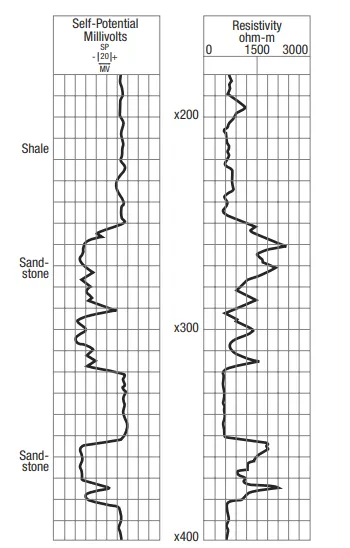
An attractive hydrocarbon saturation is the third critical variable (along with porosity and reservoir height) to be determined before a well is tested or completed. A classic method, currently performed in a variety of ways, is the measurement of the formation electrical resistivity. Knowing that formation brines are good conductors of electricity (i.e., they have poor resistivity) and hydrocarbons are the opposite, a measurement of this electrical property in a porous formation of sufficient height can detect the presence of hydrocarbons.
With proper calibration, not just the presence but also the hydrocarbon saturation (i.e., fraction of the pore space occupied by hydrocarbons) can be estimated. Figure 1-2 also contains a resistivity log.
The previously described SP log along with the resistivity log, showing a high resistivity within the same zone, are good indicators that the identified porous medium is likely saturated with hydrocarbons.
The combination of porosity, reservoir net thickness, and saturations is essential in deciding whether a prospect is attractive or not. These variables can allow the estimation of hydrocarbons near the well.