




Since crude oil and natural gas are nonconductors of electricity, their presence in reservoir rock increases resistivity. The resistivity index or ratio, I, is commonly used to characterize reservoir rocks that are partially saturated with water and also contain oil and/or gas:

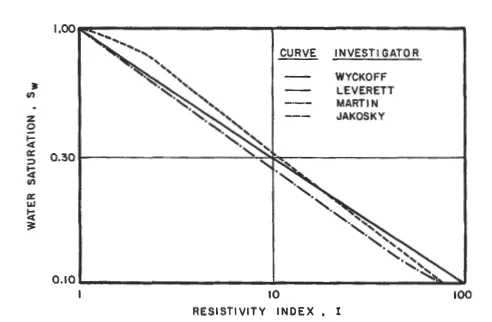
where R, is the resistivity of the rock at some condition of partial water saturation, S, and R, is the resistivity of the rock when completely saturated with water or brine. Citing the work of Martin et al. [74], Jakosky and Hopper [75], Wyckoff and Botset [%I, and Leverett [77], in which the variation in resistivity with water saturation was studied, Archie [42] plotted the resistivity ratio versus Sw on loglog paper (see Figure 536). For water saturations down to about 0.15 or 0.20, the following approximate equation appeared to hold, regardless of whether oil or gas was the nonconducting fluid.

where n has been commonly referred to as the saturation exponent. For clean sands and for consolidated sandstones, the value of n was close to 2.0, so the approximate relation was given by Archie as:

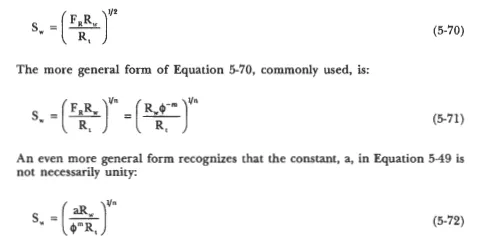
By substituting the equation for Ro (refer to Equation 5-47), Archie presented the relationship between water saturation, formation resistivity factor, brine resistivity, and the resistivity of the rock at the given Sw:
The foregoing equations are close approximations in clean formations having a regular distribution of porosity. The accuracy of the equations will not be as good in formations with vugs or fractures.

