
Digital systems are designed to store, process, and communicate information in digital form. They are found in a wide range of applications, including process control, communication systems, digital instruments, and consumer products. The digital computer, more commonly called the computer, is an example of a typical digital system.
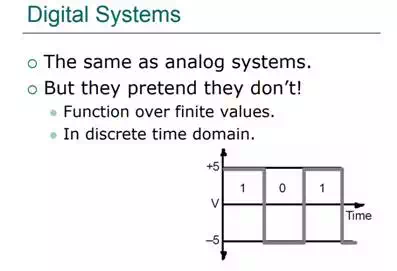
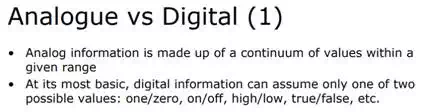
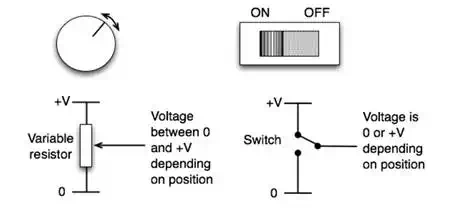
A computer manipulates information in digital, or more precisely, binary form. A binary number has only two discrete values — zero or one. Each of these discrete values is represented by the OFF and ON status of an electronic switch called a transistor. All computers, therefore, only understand binary numbers. Any decimal number (base 10, with ten digits from 0 to 9) can be represented by a binary number (base 2, with digits 0 and 1). The basic blocks of a computer are the central processing unit (CPU), the memory, and the input/output (I/O). The CPU of the computer is basically the same as the brain of a human. Computer memory is conceptually similar to human memory. A question asked to a human is analogous to entering a program into the computer using an input device such as the keyboard, and answering the question by the human is similar in concept to outputting the result required by the program to a computer output device such as the printer.
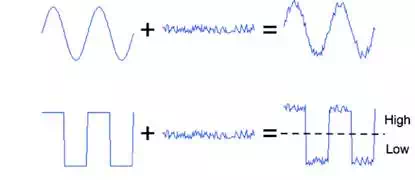
Advantages of Digital Systems
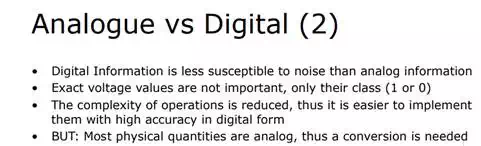
1. High noise immunity
2. Adjustable precision
3. Ease of design (automation) and fabrication, therefore, low cost
4. Better Reliability
5. Less need to calibration and maintenance
6. Ease of diagnosis and repair
7. Easy to duplicate similar circuits
8. Easily controllable by computer
Disadvantages of Digital Systems
1. Lower speed
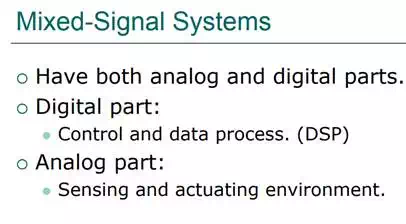
2. Needs converters to communicate with real world, therefore more expensive and less precision
· Digital to Analog (D/A)
· Analog to Digital (A/D)